5 Progressive Drills to Fix Acceleration Technique and Build Explosive Speed
Acceleration is the foundation of athletic speed. Whether you’re a track sprinter exploding out of the blocks, a soccer player beating a defender to the ball, or a young athlete learning how to move efficiently, the first few steps often decide the outcome. Yet many athletes struggle here—sitting back into their hips, chopping their feet without projecting forward, collapsing their posture, or losing coordination as soon as resistance or speed increases.
These problems rarely fix themselves with more free sprinting alone. What works better is a clear, progressive sequence that isolates the key positions and forces, then gradually adds complexity until the skill transfers into real sprinting.
The five-drill progression below (inspired by coach Samuel Kwong’s practical approach) does exactly that. It moves athletes from a completely supported position where they can focus purely on body shape, through dynamic and resisted variations that demand force production while holding posture, and finally into free sprinting from varied starts. The result is better acceleration mechanics that actually stick.
1. Wall Drills — Learn the Position
Purpose: Teach correct acceleration posture without the demands of speed or trunk stability.
Wall drills strip everything away so the athlete can feel the ideal body shape. Hands are placed on a wall at roughly shoulder height, body leans forward into a straight line from head to heel, and the athlete drives one knee up while the other leg extends powerfully into the ground.
Key coaching points:
- Maintain a rigid torso—ribs down, hips tall, no arching or collapsing.
- Drive the knee forward and slightly upward while pushing the opposite foot back through the ground (think “push the wall away”).
- Keep the shin angle negative (shin angled backward relative to the ground) on the contact leg.
- Focus on body shape first; rhythm and speed come later.
Because the wall provides support, athletes can hold the positions longer and make precise corrections. This is especially valuable for younger athletes still developing body awareness. Typical prescription: 2–4 sets of 6–10 drives per leg, performed slowly and deliberately at first, then with increasing intent.
2. A-Skips — Maintain the Position Dynamically
Purpose: Progress from a supported static position into coordinated movement while reinforcing posture, rhythm, and foot placement.
Once the wall position feels solid, A-skips introduce rhythm and coordination. The athlete skips forward with a high knee drive, active arm swing, and a quick “snap” of the foot down under the hips. The emphasis remains on the same body angles learned at the wall, but now the athlete must maintain them while moving.
Key coaching points:
- Keep the torso relatively stable and slightly leaned forward.
- Land the foot under (or slightly behind) the center of mass—avoid reaching out in front.
- Coordinate opposite arm and leg action so the movement feels rhythmic rather than stiff.
- Maintain dorsiflexion (toes up) and a quick ground contact.
A-skips bridge the gap between pure position work and actual running. They improve neuromuscular timing and help athletes feel how the acceleration posture works in a flowing pattern. Do 3–4 sets of 15–30 meters, focusing on quality over speed.
3. Banded Accelerations — Hold Posture While Producing Force
Purpose: Add resistance that encourages forward hip projection and correct body angle while the athlete applies force.
A resistance band (usually held by a partner or anchored behind the athlete) creates horizontal pull that forces the hips to stay forward and the body angle to remain aggressive. The athlete accelerates against the band for a short distance, feeling the need to push hard through each step rather than sit back.
Key coaching points:
- Drive the hips forward into the resistance—don’t let the band pull you upright or cause you to “sit.”
- Push the ground away with each step; avoid quick, short “fast feet” that produce little projection.
- Keep the same posture cues from the wall and A-skips.
- Release the band at a predetermined point if using a partner-held variation, then continue into free acceleration for contrast.
This drill teaches athletes that posture and force production must happen together. The resistance slows the movement just enough for them to feel and correct errors in real time. Typical work: 4–6 short accelerations of 10–20 meters.
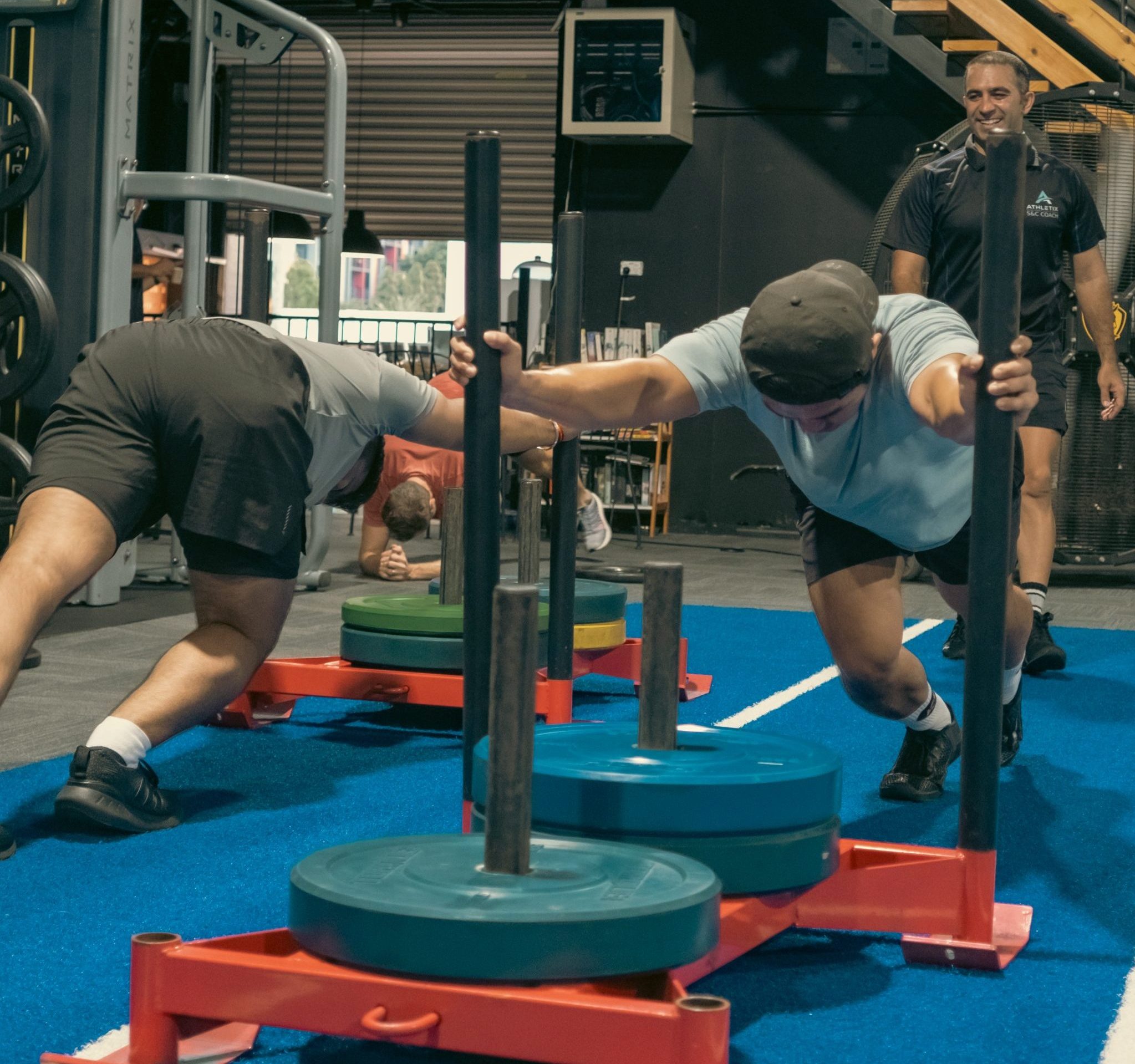
4. Sled Sprint — Emphasize Force Application
Purpose: Overload horizontal force production so athletes learn to push powerfully into the ground rather than relying on rapid foot turnover alone.
A sled (or prowler) with moderate load slows the athlete down, demanding greater force with every step. The added resistance keeps the body in a longer acceleration posture and makes weak or incomplete pushes obvious.
Key coaching points:
- Load the sled so the athlete is slowed to roughly 85–90% of free-sprint speed—heavy enough to challenge force but light enough to preserve good mechanics.
- Focus on powerful, complete pushes through the full foot rather than quick chopping steps.
- Maintain forward lean and hip projection; the sled should feel like an extension of the drive phase.
- Keep arm action strong and coordinated.
Sled work is excellent for building the strength and intent needed for explosive starts. Because the resistance reduces the temptation to spin the wheels, athletes often discover how much more force they can apply when they project properly. Use 4–8 repetitions of 10–30 meters with full recovery.
5. Free Sprints from Different Starts — Transfer the Skill
Purpose: Apply everything learned into real sprinting under varied conditions so the technique becomes automatic.
The final step removes all external support and resistance. Athletes perform free sprints from a variety of starting positions—standing two-point starts, three-point starts, falling starts, push-up starts, or even sport-specific starts. The goal is to reproduce the posture, force application, and rhythm developed in the previous drills when it actually matters.
Key coaching points:
- Carry the same body-shape and push cues into every start.
- Use different starting positions to challenge the ability to find the correct angles quickly.
- Keep distances short (10–40 meters) so the focus stays on acceleration rather than max velocity or fatigue.
- Film occasionally and compare to earlier drills to confirm transfer.
This is where the progression pays off. Athletes who have progressed systematically through the first four drills usually show cleaner, more powerful acceleration once the constraints are removed.
Putting the Progression into Practice
A typical session might look like this:
- Warm-up and mobility
- Wall drills (position focus)
- A-skips (dynamic rhythm)
- Banded accelerations (posture + force)
- Sled sprints (overloaded force)
- Free sprints from varied starts (transfer)
Keep total volume moderate, especially with younger athletes. Quality of movement always comes before quantity. Rest fully between high-intent efforts so technique doesn’t break down.
This simple sequence addresses the most common acceleration faults by building the skill layer by layer. Athletes first learn the shape, then learn to hold it while moving, then learn to produce force within that shape, and finally prove they can do it when nothing is holding them up or slowing them down.
Master these five drills in order and the first few steps of every sprint become more powerful, more efficient, and more consistent—exactly what youth development, track, and field sports demand.